Each year, our DPUB Summit is an essential meeting place for the global digital book community. We bring together 120+ experts to discuss the latest challenges and innovations in how we produce, distribute, and read digital content.
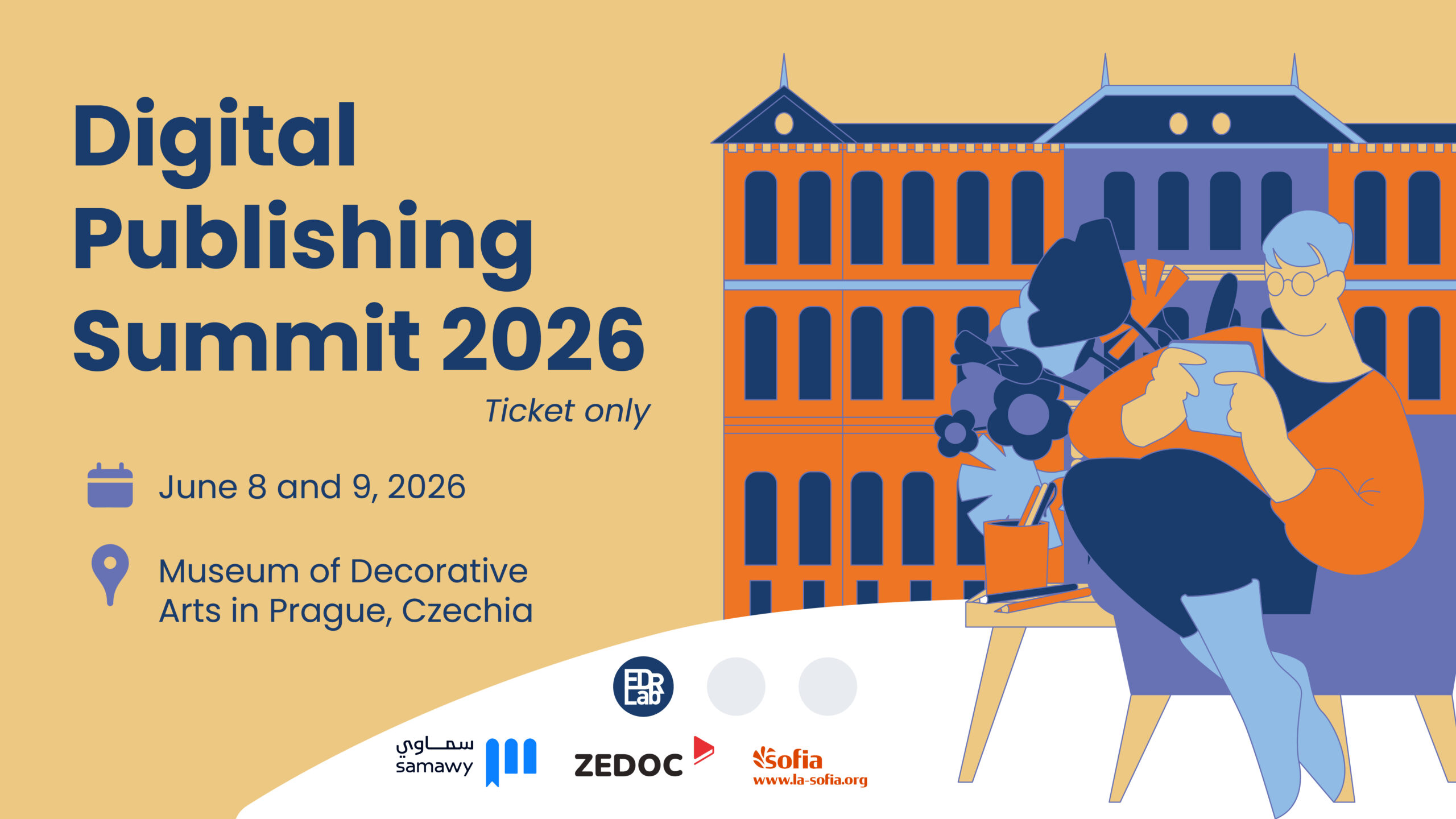
The 2026 edition will be held in Prague (Czech Republic) on Monday, June 8 and Tuesday, June 9, in the exceptional setting of the Museum of Decorative Arts, a venue that perfectly embodies the fusion of cultural heritage and innovation, the very balance we seek in the digital book industry.
Monday all day and Tuesday morning will be devoted to the Summit. On Tuesday afternoon (2:00-4:00 p.m.), the EDRLab general meeting will take place.
It will be followed on Wednesday, June 10, by the Thinkpub conference “Reader Engagement in the Digital Age” (free upon registration) and the Readium Dev Day (free upon registration). If you would like to extend your stay even further, we would also like to inform you that the XML Prague conference is taking place a few days earlier, from June 4 to 6. EDRLab attendees receive a 20% discount code for XML Prague (sent with your ticket confirmation).
Monday, June 8
- 9:15 Opening speech
- 9:30 Scaling Digital Textbooks Nationwide
- 10:05 Implementing Universal Publishing
- 10:40 Companioning publishers’ digital journeys
- 11:45 The Death of the "Franken-stack"
- 12:20 LUNCH BREAK
- 13:40 How discoverability works today
- 14:15 Evaluating Accessibility metadata
- 14:50 Amlet as the Trust Layer for the Creative AI Economy
- 15:25 Kobo Plus and the Evolution of Subscription Models
- 16:00 BREAK
- 16:30 Co-designing reading experiences for low literacy users
- 17:05 Fixed layout publications in the age of EAA
- 17:40 Meet our sponsors
- 18:10 Lightning Talks
- 18:30 Cocktail Reception
Welcoming remarks
EDRLab’s 10th Digital Publishing Summit will be inaugurated by EDRLab President Arnaud Robert.
 With a rich background in publishing, including his role as Group General Counsel and Institutional Relations Director at Hachette Livre, Arnaud Robert brings a unique perspective to the forefront of digital publishing. As chairman of SOFIA and the Legal Committee of the French Publishers Association, he has extensive knowledge of the legal and institutional frameworks governing our industry.
Scaling Digital Textbooks Nationwide: Readium, Web Publications, and DRM in Brazil’s PNLD Ecosystem
Brazil’s National Textbook Program (PNLD)—one of the country’s oldest public policies, with over 85 years of existence—is managed by the National Education Development Fund (FNDE) and the Ministry of Education (MEC) and is undergoing a large-scale digital transformation to deliver accessible, interactive, and intelligent textbooks to nearly 40 million students. This presentation explores the architecture behind the PNLD Interactive Reader (LIP), a Readium-based, multiplatform system built on the Web Publications format to ensure interoperability, progressive content delivery, and offline-first access across diverse devices and connectivity conditions. A cornerstone of this ecosystem is the adoption of Readium LCP and DRM technologies, which provide robust copyright protection for Brazilian publishers while enabling controlled distribution at national scale. The talk highlights how modular distribution, local-first synchronization, and accessibility-by-design enable equitable learning experiences while supporting rich multimedia publications. By aligning open standards, digital rights management, and inclusive design principles, the PNLD ecosystem demonstrates how public education systems can evolve from static digital books to resilient, adaptive learning platforms, offering practical lessons for large-scale deployments of interoperable reading technologies worldwide.
PRESENTED BY:
 Breno Duarte is a leading researcher at the Center for Excellence in Social Technologies (NEES), based at the Federal University of Alagoas (UFAL) in Maceió, Alagoas, Brazil. With over 30 years of experience in information technology, he holds an MSc in Computer Science and a PhD in Industrial Engineering. His research focuses on Brazil’s PNLD Digital initiative, particularly the design and evolution of accessible, interactive, and intelligent e-textbooks, as well as the development of scalable, inclusive digital reading ecosystems for public education.
From Methodology to Practice: Implementing Universal Publishing at a Latin American University Press
Accessibility in digital publishing is often addressed through isolated technical fixes or limited pilot projects, rarely achieving systemic change. This case study examines how the Guide for the Implementation of Universal Publishing—a methodology originally presented at EDRLab 2024—was fully applied by the National University of Costa Rica Press (EUNA), resulting in the first comprehensive adoption of accessible digital publishing practices in the country.
The presentation is delivered as a copresentation between the methodology’s developer and the editor-in-chief who led its institutional implementation. It traces EUNA’s transition from producing a small number of high-cost audiobooks toward embedding accessibility as a transversal editorial principle across policies, workflows, formats, and team training.
Initially engaging with the methodology to meet international distribution and accessibility requirements, EUNA reframed accessibility as a core editorial value and a social responsibility. Using the Guide as a structured framework, the publisher designed a 2025 pilot project, allocated resources, prioritized accessible EPUB 3 and audiobooks aligned with WCAG 2.2 AA, and invested in internal capacity building for editors and designers.
The methodology enabled accessibility to be integrated upstream: author submission guidelines were updated, editorial and production processes were redesigned to ensure semantic structure and navigability, and validation workflows were standardized using international tools and reading systems. By 2025, EUNA had produced and distributed over 30 accessible ebooks and positioned itself as a national reference for inclusive publishing.
This case demonstrates how a practical, scalable methodology can translate universal publishing from training into sustained institutional transformation—particularly in regions where accessibility legislation is still emerging.
PRESENTED BY:
 Marianela Camacho-Alfaro is a philologist and linguist, and an editor with nearly 20 years of experience in academic journals and book publishing. She has served as advisor, representative, and collaborator in the fields of publishing and literature for the Colegio de Costa Rica (Ministry of Culture and Youth), the National Council for Reading, Books, and Libraries, the Costa Rican Book Chamber, and the Association of University Presses of Latin America and the Caribbean (EULAC). She has edited and compiled several books and has published articles on literature, publishing, and electronic books.
 Ana María Bermúdez is an editorial accessibility specialist and one of the emerging voices on publishing accessibility in the Spanish-speaking world. She is the founder of Book Ally, an initiative that supports publishers across Latin America in adopting universal publishing through practical tools, training programs, and workflow-based methodologies. Ana María is the author of the Guide for the Implementation of Universal Publishing in Mexican Publishing Houses―a methodology that supports publishers across Latin America in adopting accessibility as a core editorial practice―and has presented her work at EDRLab events, the International Publishers Congress of the IPA, and multiple regional publishing conferences. She currently works as a Non-Fiction Publisher at Penguin Random House Mexico.
Round table: companioning publishers’ digital journeys
The digital transformation of publishing continues to accelerate, reshaping production workflows, distribution channels, and reading experiences. In this round table, experts representing the interprofessional ecosystem will discuss how the sector can accompany publishing houses of all sizes in their digital evolution.
Together, we’ll explore concrete initiatives that foster digital upskilling, innovation, accessibility, and sustainable growth across the value chain. This session will shed light on how collaborative frameworks between trade bodies, public agencies, and technology partners can empower publishers to navigate digital transitions efficiently and inclusively.
Join us to discover how the publishing community is strengthening its collective capacity for change — and what upcoming resources and programs can help drive digital readiness across Europe.
WITH:
 Deborah Nelson is the Chief Executive Officer of eBOUND Canada, a not-for-profit organization that helps Canadian publishers navigate the global digital marketplace. eBOUND supports Canadian independent publishers with conversion services, digital asset management, distribution and sales to international vendors. Research and education is also part of our service offerings, helping prepare publishers for emerging technologies such as accessibility standards and artificial intelligence. eBOUND Canada is the trusted source for all things digital in Canadian publishing and is proud to have created the first accessibility certification in Canada. Earlier in her career, Deborah worked with Pearson Education supporting the integration of technology in education. Her lifelong passion for reading and learning has shaped a career dedicated to supporting the evolution of publishing, education and technology.
 Cristina Mussinelli is the secretary general of Fondazione LIA, a non-profit organization created in 2014 by AIE (Italian Publishers Association) in collaboration with UICI (Italian Union of the Blind and Visually Impaired), which promotes the development of accessible digital reading in the publishing market. She has been involved in issues related to accessibility and technological innovation since the early 2000s. She is also an AIE consultant for digital publishing, a member of the Board of EDRLab (European Digital Reading Lab), the W3C Digital Publishing Business Group, and the Daisy Consortium, and an expert in the ISO OT UNI/CT 014/SC 04 “Automation and Documentation” section.
 Alisa Žarkova is the Head of the Publishing Department at the Lithuanian Audiosensory Library. With over 15 years of experience in the publishing field, including significant expertise in accessible publishing, she leads the coordination of publishing processes, the development of accessible content, and the implementation of strategic editorial initiatives. Alisa is dedicated to making culture and information accessible to all and actively contributes to interdisciplinary and international projects that promote innovation in inclusive publishing.
The Death of the “Franken-stack”
Unified Commerce as the Strategy for Sustainable Publisher Growth in 2026
Most publishers today are fighting a ‘Franken-stack’—a patchwork of disparate tools for print fulfillment, digital delivery, and tax compliance that kills margins and fragments the reader experience. This session demonstrates how transitioning to a unified commerce model allows publishers to reclaim their D2C data, simplify global B2B bulk sales, and turn compliance into a competitive advantage. Join us to learn how to streamline your commercial operations and build a future-proof revenue engine.
- The “Hidden Tax” of Disconnected Systems
The Problem: Explain how using one vendor for eBooks, another for print, and a third for global VAT creates “friction leaks” where up to 20% of potential revenue is lost to administrative overhead and cart abandonment.
The Reality: Readers in 2026 don’t distinguish between “buying a book” and “reading a book”—if the transition isn’t instant, they leave.
- Unified D2C (Print + Digital in One Cart)
The Revenue Multiplier: Show how a single checkout for all formats (Print, eBook, Audiobook) increases Average Order Value (AOV).
Global Without the Headache: A look at how “Merchant of Record” models (like Glassboxx) solve the global tax/VAT problem, allowing small-to-midsize publishers to sell into 100+ countries overnight without a massive accounting team.
- Frictionless B2B & Bulk Sales
The Untapped Market: Selling directly to schools, corporations, and libraries.
The Solution: Demonstrate how token-based systems and white-label “Academic Readers” allow publishers to sell 500 copies of a digital title as easily as one, maintaining control over the license without complex manual distribution.
- “Why Now?” (Compliance & Data)
Beyond the Book: Why owning the customer data (first-party data) is the only way to survive in an AI-driven discovery world.
The Action Plan: Three steps to audit your current “Franken-stack” and move toward a unified commercial strategy for the rest of 2026.
PRESENTED BY:
 Erik Pattenden, Projects Director at Glassboxx/Firsty Board.
A buffet lunch will be served, courtesy of our sponsors Samawy and Zedoc AI.



What Happens When Everyone Can Publish, but Not Everyone Can Be Found
Publishing has never been more open. Creating and distributing a book is easier than ever, and professional tools are accessible to more authors and publishers than at any point in history. Yet as volume grows, visibility becomes the real challenge. Books are published, but they disappear. In a world of endless choice, discoverability is no longer driven by a single launch, platform, or tactic. Readers are overwhelmed. Algorithms rely on imperfect signals. Valuable, original books struggle to surface while noise increases across storefronts and formats.
This session explores how discoverability works today and why it is a systems challenge, not a creative failure. The fundamentals are familiar: accurate metadata, category alignment, effective presentation, broad availability, accessibility, and relevance to reader intent. What changed is the scale at which these must be applied. New workflows make it possible to apply these principles consistently. Tools, including AI, help improve metadata, support accessibility standards (including EAA-related requirements), expand into new languages, and reach readers across platforms and formats. Paired with process and content verification, they amplify what works and help valuable content rise.
We will also examine how copycat and low-quality content harms discovery for everyone, and why protecting verified, original content improves outcomes for readers and creators alike. Attendees will leave with:
- Why discoverability breaks at scale
- How metadata, accessibility, formats, and languages act as discovery signals
- Where AI helps, and what still requires process and verification
PRESENTED BY:
Stephen Griffin is Growth Director at PublishDrive, with over a decade of experience in IT and SaaS-driven businesses. His work spans platform strategy, product positioning, data-led growth, and the operational realities of running large-scale digital systems. At PublishDrive, he works closely with authors and publishers worldwide, focusing on how technology, infrastructure, automation, and data shape publishing workflows, distribution, monetization, and long-term scalability across formats, platforms, and markets.
Earlier in his career, Stephen worked in competitive sports and sports science environments, where performance analysis, measurement, and continuous improvement are core disciplines. That background influences how he approaches technology-led businesses today: emphasizing systems thinking, feedback loops, and evidence-based decision-making when operating at scale.
Evaluating the Accuracy and Correctness of Accessibility Metadata in Finnish E‑books
Accessibility Library Celia and Ellibs Ltd. collaborate to examine the accuracy of accessibility metadata supplied by Finnish publishers for their e‑books. Celia, now part of the National Archives of Finland, serves people with print disabilities, produces accessible books, and provides guidance on accessible publishing. Ellibs is a Finnish pioneer in digital literature and e‑materials, distributing e‑books and audiobooks and partnering with publishers, libraries, and corporations in Finland and across Europe.
Ellibs uses the W3C Accessibility Metadata Display Guide for Digital Publications 2.0 to present publisher‑provided metadata to end users. Our study evaluates how well this metadata reflects the actual accessibility features of publications and how consistently it follows guidance and standards.
The presentation will introduce key findings from a review of accessibility metadata drawn from a broad sample of recent Finnish e‑books. This review will be conducted by experts from Celia during spring 2026, combining metadata analysis with practical evaluation of real‑world publication examples.
A central question explored in the session is whether intermediaries such as Ellibs can reliably present publisher‑provided accessibility metadata as is, or whether additional validation, enrichment, or correction processes are needed. The discussion will address risks associated with inaccurate metadata, as well as the benefits of clearer quality‑assurance practices across the publishing chain.
The project also aims to support publishers in producing more accurate accessibility metadata by refining the Finnish Best Practices of an Accessible E‑book, first released in 2024. Another goal is to clarify for distributors and online bookstores how and when to use ONIX or schema.org.
PRESENTED BY:
 Miia Kirsi works as an accessibility specialist at Accessibility Library Celia since 2019, focusing on accessible publishing, digital workflows, e‑learning, and document accessibility. She participates in several expert groups, including the Nordic Inclusive Publishing Initiative WG, the W3C Nordic Accessibility Community Group, and the Finnish Advisory Board for Plain Language.
Before joining Celia, she spent a decade in the Finnish publishing industry as an editor and e‑learning coordinator. She holds a BA from the University of Helsinki and is currently completing an MS in Accessibility and Diversity in Digital Services at Tampere University, specializing in inclusive publishing research.
 Pirjo Kangas works as a Senior Account Manager at Ellibs Ltd. focusing on digital literature needs of library customers and business development. She also has more than 10 years of work experience as a librarian specialising in library systems and digital resources.
Pirjo has a MA degree from University of Turku and a B.Soc.Sc. degree from Åbo Akademi University. Pirjo was awarded a Fulbright Finland Mid-Career Professional Development Grant in 2019 with her project AI for librarians. She is an active member in the Finnish Research Library Association (STKS) new technologies group and has published professional articles in several journals related to librarianship.
Amlet as the Trust Layer for the Creative AI Economy
AI is rapidly changing how digital content is discovered, analyzed, and reused. Yet the publishing world still lacks a clear and reliable method to signal permissions for text and data mining and to license content for AI training in a transparent and scalable way. Amlet addresses this need with a registry powered by the ISCC open standard, which offers a universal and interoperable fingerprint for any digital work expression.
Amlet allows publishers and creators to register their catalogs, declare machine-readable permissions, and provide lawful access to AI companies while retaining full control of their rights. This creates a trusted layer that connects the creative sector with the AI sector and enables compliance with emerging regulations such as the EU AI Act.
The session will present the core principles behind the ISCC standard, the architecture of the Amlet registry, and concrete use cases from our initial deployments with publishers and industry partners. It will also outline how an open, shared, and verifiable rights layer can improve transparency, reduce friction, and create new economic opportunities for rights holders while supporting responsible AI development at scale.
The goal is to show a practical path for the publishing industry to take an active role in the AI era by adopting open standards and building infrastructure that benefits creators and innovators alike.
PRESENTED BY:
 Giacomo D’Angelo is the co-founder and CEO of Amlet.ai and the CEO of StreetLib.com, a global digital publishing platform that manages more than 1 million titles and operates across Italy, Germany, and the United States. Active in the international book world for more than a decade, he has driven StreetLib’s expansion by focusing on digital innovation and the evolving role of books in a connected world. With Amlet he is now building an open and transparent infrastructure for rights awareness and responsible AI, with the goal of creating new opportunities for publishers and creators in the emerging AI economy.
Unlocking Reader Engagement: Kobo Plus and the Evolution of Subscription Models in Global Digital Publishing
In an increasingly competitive digital landscape, understanding and adapting to new business models is paramount. This presentation will delve into the strategic development and global impact of Kobo Plus, Rakuten Kobo’s successful all-you-can-read ebook and audiobook subscription service.
We will explore how Kobo Plus has redefined reader engagement by offering unparalleled access to diverse content, driving consumption, and fostering a vibrant reading community across various international markets. This, combined with our experience in managing diverse content across global markets, would provide a compelling case study on the operational strategies, market-specific adaptations, and key learnings from implementing a scalable subscription model.
Attendees will gain insights into the complexities of digital content licensing, the nuances of global market expansion, and the continuous innovation required to meet and anticipate evolving reader demands in the subscription economy.
PRESENTED BY:
Michael Tamblyn is the CEO of Rakuten Kobo, one of the world’s largest eBook retailers and makers of eReaders. Part of the founding team since 2009, he became CEO in 2016, guiding Kobo from a Canadian startup to a global brand now in 30+ countries. A lifelong reader, Michael believes digital platforms should make reading lives better, not just digital, and has pushed Kobo to experiment with both hardware and software to keep eBooks open and accessible worldwide. He speaks internationally on publishing, tech, and innovation, and is deeply involved in shaping the global e-reading landscape through strategic partnerships and new business model development.

Tea and coffee will be served. Many thanks to our sponsors for making this service possible.
Co-designing reading experiences for low literacy users
Digital libraries offer great potential to move beyond one-size-fits-all reading formats. While accessibility efforts have traditionally focused on visual adjustments, a truly inclusive reading experience requires a broader and multimodal approach. We want to combine text with audio (karaoke reading), translation, summarization and other supportive layers to make sure digital publications can better serve users who experience reading barriers.
At the KB National Library, we are developing Proeftuin LeesMakkelijk, which is a digital reading lab. This is a user-centred experimentation environment in which new reading functionalities are co-created, tested and refined together with the user. Rather than conducting isolated usability tests, we are working with continuous user panels. This allowes us to iteratively explore design choices, technical decisions and user agency over time.
Our initial focus has been on low-literate native (NT1) and non-native (NT2) readers, but we are expanding to include users with dyslexia, visual impairments, and neurodivergence as well. Within the Proeftuin Leesmakkelijk, we are testing a range of reading support features such as different forms of read-along support, in-text translation, descriptions and summarising functions. The emphasis is not on a single solution, but on understanding how combinations of features and design choices affect reading comprehension and language agency.
A core principle of this work is open infrastructure. The reading components developed in the lab are released as open source, enabling other organizations such as EDR Lab, to reuse them and contribute to their further development. This way we can collectively improve the quality and sustainability of these accessibiliy features.
In this presentation I will demonstrate how an open testing ground, which is supported by rapid A/B(/C) testing and co-creation, can help turn accessibility requirements into inclusive and scalable reading experiences for all. The aim is to inspire publishers, libraries, and technology providers to collaborate on accessible digital reading as a shared responsibility.
PRESENTED BY:
 Marre Westerbeek (they/she) works at the intersection of digital reading technology, language accessibility, and user research at the KB National Library of the Netherlands. With a background in re-translation, Dutch as a Second Language (NT2) education, and language access studies, they focus on developing and testing multimodal reading experiences together with users who experience reading barriers. Their work combines participatory design, user agency research, and open-source principles. In hopes of turning accessibility standards into better reading solutions for low-literacy users.
Preserving design, ensuring accessibility: fixed layout publications in the age of EAA
Fixed layout documents — PDF and EPUB fixed layout — are essential for preserving the visual integrity of publications such as illustrated children’s books, comics, art books, and complex publications. But how can we ensure that they are accessible to everyone, while complying with the requirements of the European Accessibility Act?
This session addresses the heart of the problem: in fixed layouts, the beauty of design can become a barrier. Absolutely positioned text on the page, ambiguous reading order, and the inability to change size and spacing can create obstacles for users with visual, cognitive, or motor disabilities.
Based on the work developed at the World Wide Web Consortium (W3C) with the document “EPUB Accessibility – Fixed Layout Challenges and Best Practices,” this session will present the challenges and advantages of producing accessible fixed layout documents.
PRESENTED BY:
 Gregorio Pellegrino, Chief Accessibility Officer at Fondazione LIA, is an Italian software engineer with a strong focus on improving digital accessibility for visually impaired individuals. His expertise is reflected in his co-editing of key industry documents, such as W3C EPUB Accessibility 1.1, the Accessibility Metadata Display Guide for Digital Publications 2.1, and the EPUB Accessibility – EU Accessibility Act Mapping. He is also technical leader of the DAISY Consortium’s “Accessible EPUB from InDesign Expert Group,” working with Adobe to enhance the accessibility of EPUBs exported from InDesign. Pellegrino’s work with organizations like W3C, DAISY, and EDItEUR helps shape global accessibility standards. Through his consulting, training, and standards development efforts, he continues to support more inclusive reading experiences in digital publishing.
Muhammed Salah will present Samawy’s latest projects.
Njål Hansen will introduce us to Zedoc AI.
Lightning Talks: Innovation in Action
This session offers a series of fast-paced presentations showcasing exciting new projects and initiatives from leading organizations in digital publishing.
_________________
Want to be featured? You can send us your proposal : contact@edrlab.org.
Cocktail Reception
Tuesday, June 9
- 9:00 Update on Standards
- 9:30 Thorium Suite
- 10:15 LCP Checkpoint
- 10:35 Interoperable Ecosystem for Scholarly Digital Publishing
- 11:15 Building solutions on top of EDRLab technologies (1/2)
- 11:40 Building solutions on top of EDRLab technologies (2/2)
- 12:00 Closing remarks & LUNCH
- 14:00 EDRLab Annual General Meeting
- 16:00 = The End =
Update on Standards
This session will provide a comprehensive overview of the key developments and future directions in digital publishing standards.
PRESENTED BY:
Laurent Le Meur has been the Technical Director of EDRLab since its creation.

Hadrien Gardeur, co-founder of EDRLab with over 18 years of experience in digital publishing and lead architect on Readium projects.
 Gautier Chomel, who has been making books behave properly for a mere 25 years spends his days ensuring digital books don’t embarrass themselves in public. He’ll share insights on how community groups keep publishing standards alive, kicking, and occasionally arguing — all in the name of better reading for everyone.
Gregorio Pellegrino, Chief Accessibility Officer at Fondazione LIA, is an Italian software engineer with a strong focus on improving digital accessibility for visually impaired individuals.
Thorium Suite
This session will present the Thorium Suite: Thorium Desktop and Thorium Mobile.
PRESENTED BY:
 Daniel Weck, a software engineer working with EDRLab and the DAISY Consortium, who has been a lead developer in the Readium project for over a decade, with a strong focus on accessibility. Daniel will share his insights on the roadmap for Thorium, drawing from his extensive experience in developing open-source software for digital publishing and accessible media.
LCP Checkpoint — Tracking the Global Adoption of Readium LCP
Readium LCP is an open, interoperable DRM standard (ISO/IEC 23078‑2) that protects ebooks, audiobooks, and PDFs while preserving accessibility and user privacy. Operated worldwide by EDRLab, LCP powers lending, sales, and subscription models without requiring third‑party accounts. Because LCP is a distributed technology, there is no central source of data on adoption — how many titles use LCP, in which countries and languages, or how many licenses are issued each year.
This session presents the first consolidated view of global LCP usage, based on surveys and interviews with implementers. We’ll share emerging trends, key insights, and next steps for more reliable adoption tracking.
PRESENTED BY:
Laurent Le Meur has been the Technical Director of EDRLab since its creation.
 Priyanka Dalotra, LCP Product Manager at EDRLab.
Adopting open standards to build an Interoperable Ecosystem for Scholarly Digital Publishing
Casalini Libri, a long‑standing bibliographic agency and supplier of academic and research publications in the Humanities and Social Sciences, has progressively expanded its digital distribution as part of its evolution into an international group with Erasmus Boekhandel and AtCult software house. Since the early 2000s, the organisation has relied on Adobe DRM to protect and deliver e‑content through the Casalini e‑Library. Although effective as a turnkey rights‑management system, Adobe DRM has imposed several limitations, including proprietary constraints, lack of Linux support, PDF‑only workflows, and reliance on Acrobat as the sole reading application.
To modernise its digital ecosystem and support diverse formats such as EPUB, PDF, and audiobooks, the renewed Torrossa platform began transitioning to an open, standards‑based framework built on Readium and LCP. This required re‑engineering the previous DRM model to maintain institutional licensing practices based on “packaged” authorisations while adopting interoperable, vendor‑neutral protection mechanisms.
Key developments include integrating Readium into the Torrossa Reader for cross‑platform rendering, deploying LCP for standardised DRM across formats, implementing lending services, adopting OPDS for decentralised and device‑native discovery, and introducing a server‑side licence‑delivery architecture optimised for library workflows.
Maintaining both Adobe and LCP environments has presented technical challenges, such as custom business logic, coordination of evolving Readium‑LCP toolchains, and ongoing interoperability and accessibility testing across diverse systems.
Upcoming enhancements include integrating Thorium Web for streaming and assessing Torrossa Reader apps across any client platforms. This transition marks a significant strategic shift toward an interoperable, and scalable distribution model, powered by emerging open‑source digital‑publishing technologies.
PRESENTED BY:
Lorenzo Brambille began his career as a software developer in the document-management field, specializing in Adobe systems. He has been collaborating with Casalini for years, and since 2019 he has started exploring the open-source Readium technology: he worked on setting up the Thorium desktop and mobile applications, customizing them for Torrossa, handled the integration of the LCP server in the platform’s production environment, and is currently working to combine the opportunities offered by OPDS with the needs of academic library users.
 Luisa Gaggini has held key roles at Casalini Libri, initially in foreign acquisitions and sales, and for several years has led the Digital Division. She oversees e‑content distribution contracts for the Torrossa platforms, with a focus on sales models, licensing for institutional and e‑commerce channels, and online services. She regularly participates in industry events and lectures for the Informatica del Testo Master’s program at the University of Siena. She is involved in WGs defining Torrossa reading solutions and roadmap to accessibility, in collaboration with the LIA Foundation. Luisa also serves on the board of the European Digital Reading Lab.
Building solutions on top of EDRLab technologies: Ellib’s experience
The presentation will focus on Ellibs’ experiences working with EDRLab technologies since 2023. We will discuss the technologies currently in use, as well as our experiences with them and our future plans. The technologies covered include Readium Toolkits, Readium LCP, Thorium Reader, OPDS feeds and Thorium Web. Key aspects we have aimed to improve through the implementation of these technologies include interoperability, accessibility and user privacy in our services aimed at our library customers.
Ellibs, founded in 2003, is a Finnish provider of digital literature services, managing the distribution, licensing, DRM and sale of electronic books between publishers, libraries and readers. Ellibs partners include numerous publishers, libraries and corporations in Finland and across Europe. Ellibs maintains an online store for e-books and audiobooks as well as reading applications in browsers and on mobile devices.
Ellibs has been building solutions on top of EDRLab technologies since 2023, and we are actively adopting new solutions from the EDRLab ecosystem to update and improve our services. The modular architecture of these technologies has allowed us to integrate new components into our platform to enhance functionality and user experience. For example, the adoption of Thorium Reader has improved accessibility as well as the overall reading experience for users of our products.
We will also discuss how adopting solutions based on open standards makes it possible to contribute back to the ecosystem and share our experiences collaborating with the Readium/EDRLab community.
PRESENTED BY:
Pirjo Kangas works as a Senior Account Manager at Ellibs Oy focusing working with library customers and business development.
 Sylvain Degeilh is a Technical Architect at Ellibs with over 15 years of experience in content management and library systems. He currently specializes in deploying services based on EDRLab technology across Finland.
Open standards & rapid app development: the Czytnix story
Learn how we built Czytnix, a novel platform for ebook and audiobook lending, using open standards and technologies like OPDS, Readium LCP and Thorium Web. No expensive native apps. No compromises on security or user experience. In ~300 hours.
PRESENTED BY:
 Piotr Bator (Elibri) is a Web developer with experience in the Polish publishing market. Engaged in projects like library lending in Czytnix, metadata distribution in Elibri or ebook watermarking in LemonInk. Eager agentic AI coder & automator.
Closing remarks
We will conclude this portion of the Digital Publishing Summit 2026 with a final opportunity to connect over a farewell buffet lunch. This will be a last chance to share your reflections on the past two days, exchange contact information, and solidify the connections you’ve made.
At this point, we will be hoping you have enjoyed the DPUB Summit and found it valuable. Stay tuned for information about future EDRLab events and consider subscribing to our newsletter to keep up-to-date with the latest news and opportunities!
EDRLab Annual General Meeting
This is a hybrid session; EDRLab members who cannot come to Prague will be able to participate remotely.
Its duration is 2:00h maximum so that participants can take their flight or train on the same day.

Safe travels!
Sponsoring the event
The DPUB Summit is a community-focused event. We are covering our costs via ticket sales and sponsorship opportunities.
Check our sponsorship opportunities here.
Please contact us is your are interested in associating your name to the Digital Publishing Summit.
Digital Publishing Summit Archive
Many thanks to our sponsors
Gold sponsors
Silver sponsors
With the support of the French Ministry of Culture


 contact@edrlab.org
 +33 1 83 64 41 34