
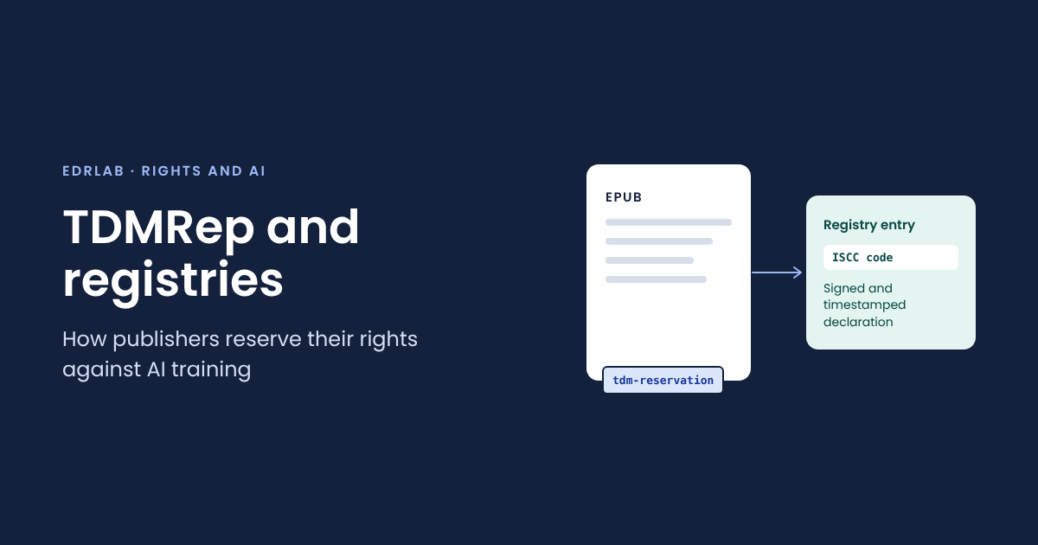
The European framework for text and data mining lets rights holders reserve their rights, so their works aren’t used to train AI models without authorisation. This article presents two tools that support TDM and AI reservation for books: TDMRep, a W3C protocol developed in a group led by EDRLab, and the Amlet registry of rights metadata, a complementary service built on open standards. It explains how each works and why a registry can add a layer of security without being mandatory.
The article draws on the EDRLab Members Circle of 30 October 2026 with Laurent Le Meur, director of EDRLab and co-editor of the TDMRep specification, and Giacomo D’Angelo, CEO of Amlet, a company that operates a registry of rights metadata. If you’d like to attend our Member Circles, please join the EDRLab membership program.
The legal framework
Article 4 of the 2019 Copyright Directive allows text and data mining for any purpose, unless the rights holder has reserved the right in an appropriate manner. For content published online, an appropriate manner is machine-readable. Article 53 of the AI Act requires providers of general-purpose AI models to respect these reservations. The obligation has applied since August 2025; since August 2026, the AI Office holds enforcement powers.
Giacomo D’Angelo summarised the principle at the session: “In Europe, silence counts as a yes.” A publisher that wishes to keep its rights therefore expresses the reservation in a form that machines can read. The legal texts do not prescribe the technical form. TDMRep was designed to provide it, and registries extend it.
TDMRep: the reservation protocol
EDRLab initiated the TDM Reservation Protocol (TDMRep), and the W3C community group has developed it since 2021. Laurent Le Meur co-edits the specification. The protocol is deliberately simple and has two properties.
tdm-reservation states “I reserve my rights” as a boolean value.
tdm-policy provides a link to a Web page that says whom to contact and which rights the holder may license.
The same two properties can be expressed in EPUB and PDF metadata, in the metadata of images, audio and video, in HTML pages and in the HTTP headers of a web server. A publisher can cover its files and its website with a single protocol. Book and press publishers already use it, and the W3C group keeps a list of adopters that includes trade publishers, academic publishers and newspapers.
Laurent Le Meur describes the scope of the flag precisely: “It means I reserve my rights. It doesn’t mean anything else.” The conditions of use are carried by the policy link. The EU Copyright Directive and the AI Act give the reservation legal effect by recognising machine-readable reservations.
When metadata does not travel with the file
TDMRep is written next to the content, in the metadata of the file or in the headers of the page that serves it. This makes it easy to deploy and easy for crawlers to read. It also means that the reservation is available as long as the content is accessed in its original form. Digital files circulate through distributors, aggregators and other services, and a copy may be converted to plain text along the way. Giacomo D’Angelo described the situation: “Those files travel the world, and there are many instances where operators strip the metadata away. In the AI training use case, AI companies take the content and strip the metadata away.” This is a legal issue by itself, as AI companies should not touch content with reserved rights.
In such a case, the text reaches a training set without its reservation. Addressing this requires a link between the text and its rights holder that does not depend on metadata. A registry provides that link.
What a registry is
A registry starts from the content itself. Giacomo D’Angelo explained the aim: “We wanted to create a system where, starting from the content itself, you can track back to the original rights holder and to the actual reservation that the rights holder made on that specific content.”
The technique is a content-derived fingerprint. The International Standard Content Code (ISCC), published as ISO 24138:2024, lets anyone compute a code from a text with a public algorithm. “This is something no AI company can strip away,” said Giacomo D’Angelo, “because it’s a calculated code that anybody can recalculate starting from the content.” The same text gives the same code on any computer.
A code alone does not say who owns a text, so the registry adds a lookup around it:
- The publisher, or its distributor, computes the code from the EPUB or PDF file.
- The publisher declares the code in the registry, along with associated rights and a link to its terms.
- An AI company computes the code of a text it holds, in its training set for example, and queries the registry.
- The registry returns the declaration.
Two properties make this useful to an AI company. The first is scale: rather than checking millions of files by crawling those signals, they just have to make one lookup. The second is provenance. The declaration is timestamped and digitally signed by the publisher, so, in Giacomo D’Angelo’s words, “you get first-party rights information, digitally signed by the publisher. There is a mathematical proof that the rights information comes from that specific publisher.”
An additional layer of security
A registry complements TDMRep.
Laurent Le Meur explained: “Registries complement what is legally enforceable. Because it is based on ISCC, a signature of the content itself, even if the reservation signal has disappeared, it can be found again on the registry just by recalculating the signature of the content and sending it as an identifier to the registry. It is a way to make the system very reliable.”
The two layers serve distinct purposes. TDMRep expresses the reservation where the file or the website is read in its original form. The registry makes the reservation retrievable from the content itself and gives the AI company a signed declaration instead of a line of metadata whose origin it cannot verify. Using a registry is a choice. A publisher that publishes TDMRep has reserved its rights, and adding a registry increases the reliability of that reservation.
An open system with several possible operators
The registry model is not tied to one company. Giacomo D’Angelo described the design choices: “We are building the registry on top of open standards. ISCC is open source, so everybody can use it. There is no lock-in, it is publicly available.” A foundation governs ISCC, separate from the companies that offer services on top of it.
A second standard, the ISCC Discovery Protocol, lets registries work together. Several registries can run on the same protocol and exchange with each other, for books, for music or for a given region, and an AI company can send one query to all of them. “It’s like the internet, basically, like HTTP,” he said. He expects registries for different types of content and different jurisdictions to exist side by side, and he mentioned that a library or a national bibliography could become one of them. Amlet, which operates a registry for book publishers, is one example of such an operator.
On durability, his position is that “even if Amlet disappears, the open ledger with all the declarations of your rights is going to be there, because this is built on open standards.” A publisher evaluating any operator can ask how that is guaranteed in practice.
The adoption of registries by AI companies depends on the application of Article 53 and on the simplicity of the lookup for a company that needs to comply. Giacomo D’Angelo considers a single query a technically easy solution.
What the publisher keeps control of
Questions about control came up in the discussion, as is usual for a recent system. The speakers’ answers can be summarised in three points.
The files stay as published. The fingerprint is computed from the content and stored in the registry, and nothing is added to the EPUB or PDF. When a digital distributor handles the files, it can compute the fingerprint on its own premises. “Amlet only receives the fingerprint,” said Giacomo D’Angelo. “We never touch the content in that scenario.” The registry then attaches the publisher’s reservation to that fingerprint.
The publisher remains the licensor. The registry publishes the rights position and the licensing terms that the publisher decides, and the operator does not sell the content.
The model is recent, and publishers are evaluating it. Giacomo D’Angelo said he is talking with large scientific and trade publishers who are running proofs of concept. A publisher can reserve its rights with TDMRep today and decide on a registry later.
Beyond the flag: which uses?
A reservation says that rights are kept. The accepted uses are described separately, in the tdm-policy link or in the registry declaration. The IETF is defining a shared vocabulary of AI usages, with publishers, news organisations and AI companies at the table. Laurent Le Meur listed the main terms. Search comes first: most publishers want to allow it, but a blanket AI reservation also covers it, because large search engines use AI in their pipelines. Training comes second, and publishers broadly want to disallow it without a counterpart. Inference comes third, when an AI system uses content to answer a question. It splits into two: a system that retrieves content on its own, without the user knowing, and a user who hands content to a system for a summary, a translation or another derivation. The second use case is still under discussion at IETF. The work is consensus-based, and the team hopes to reach a conclusion before the end of the year; EDRLab encourages publishers to take part so their views are reflected.
Accessibility is a fixed point. “TTS is basic for accessibility,” Laurent Le Meur said. “I think the consensus must be that TTS is out of the equation.” He also pointed out that refusing every term by default would exclude translation, explanations and simplified text, which some readers need for accessibility reasons.
Where to start
- Publish a TDMRep reservation on your website (HTTP headers or a
tdmrep.jsonfile) and in the metadata of your EPUB and PDF files. - Look at how your files circulate. If they pass through distributors, aggregators or retail channels that may remove metadata, a registry covers that case.
- When you evaluate a registry, check which open standards it uses and who governs them.
- State in every author contract who controls AI rights.
- Hold off on an exclusive training deal for the whole catalogue. Exclusivity is the one decision that cannot be undone.
——————–
Frequently asked questions
Do I have to join a registry to opt out of AI training in the EU?
No. The Copyright Directive and the AI Act require a reservation in an appropriate, machine-readable form. TDMRep is one way to do it, and a registry is an additional layer.
What is TDMRep?
The TDM Reservation Protocol, initiated by EDRLab and developed in a W3C community group. A rights holder states “I reserve my rights” with the tdm-reservation property and points to its terms with tdm-policy. The legal effect comes from the Directive and the AI Act.
What is a registry?
A service where rights holders declare reservation and licensing terms against a text’s fingerprint. An AI company computes the fingerprint of a text it holds and looks up the declaration.
What is ISCC?
The International Standard Content Code, standardised as ISO 24138:2024. It computes a code from a file’s content, so the same text produces the same code on any computer.
Is a registry tied to one company?
Yes and No. ISCC and the ISCC Discovery Protocol are open standards, and several registries can run on the same protocol and answer one query. Amlet is one operator among those that can exist.
Does a fingerprint change my files?
No. The code is computed from the content and stored in the registry. The published EPUB or PDF stays as it is.
Can I reserve my rights and still allow search?
Not with a single flag today, because a blanket AI reservation also covers search engines that use AI; at least that’s how the big search engine players interpret it. The IETF vocabulary being defined aims to let rights holders allow search separately.
Does reserving rights stop text-to-speech for readers who need it?
It should not. Laurent Le Meur argues that text-to-speech must remain outside the scope of any TDM opt-out.











 contact@edrlab.org
 +33 1 83 64 41 34